
MEASURED MILE OR MEASURED TIME?
When measuring speed there are two main parameters involved, time and distance, excluding weather, sea depth, currents, tide etc.
By measuring distance with respect to time the slope of the graph indicates trial speed attained. (see Ref. 1)
Since ship speed is measured in knots (1 nautical mile/hour), by measuring the time required for the ship to run from one point to the other, the speed is immediately obtained directly in knots.
This method prevailed up to now but contains map relative accuracy, observational mistakes, etc. so whenever a ship was to be delivered, it was driven up and down a measured mile distance at various RPM and her corresponding speeds thus determined.
Trial procedures are well described and will not be analysed here. (see Table 1 with references)
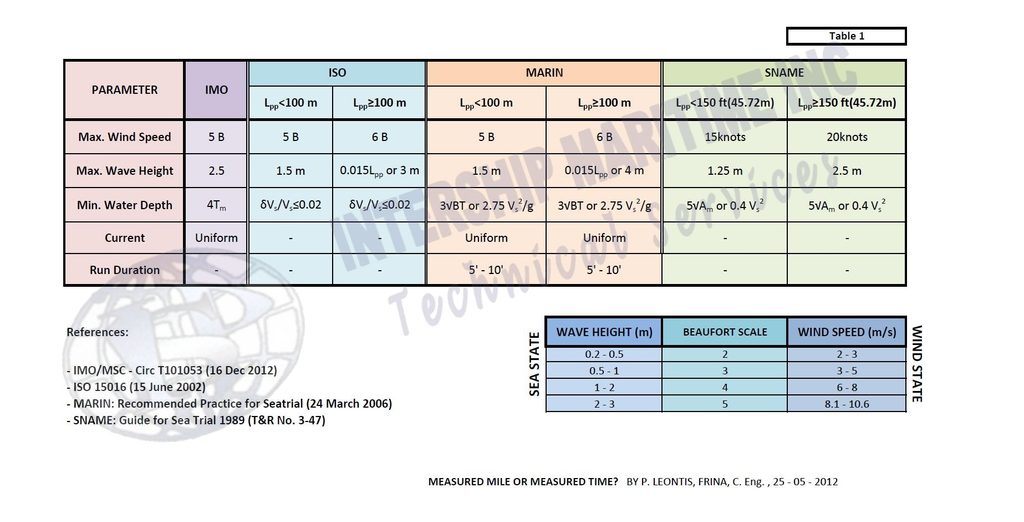
Meanwhile trial procedures have improved by using D.GPS etc. (see Ref. 1 and 2) but not always employed. However, MARIN (see Ref. 3) has pointed out that time is important and should not be less than 5’ nor more than 10’ in duration.
Now time becomes more important and distance less. Bearing in mind the advances in measuring methods, there is no need to use the single nautical mile any more. The minimum(5’) distance required for trial speed measurement greatly exceeds the single nautical mile, at today’s trial speeds.
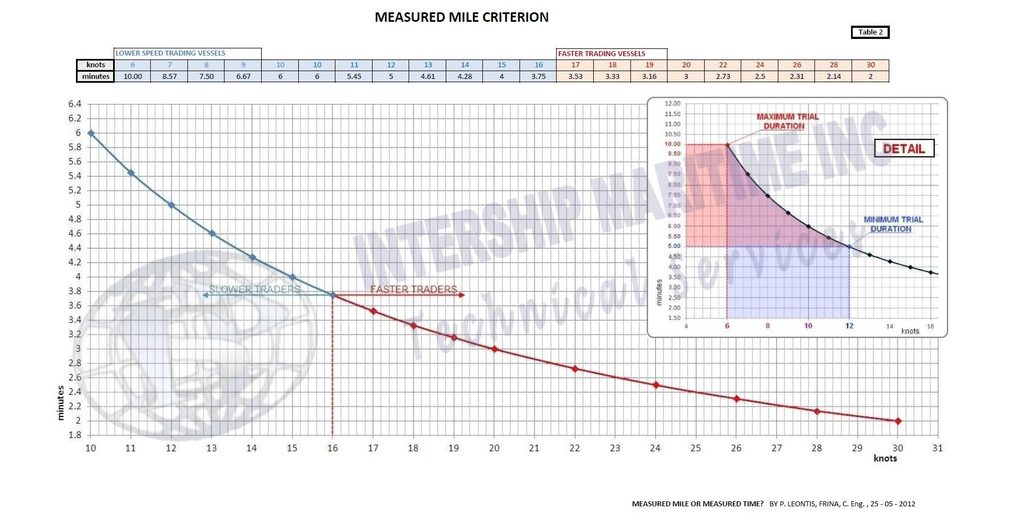
Table 2 illustrates time needed to complete the single nautical mile run. Only a trial speed of 12 knots corresponds to the measured mile distance for 5 minutes , and 6 knots for 10 minutes.
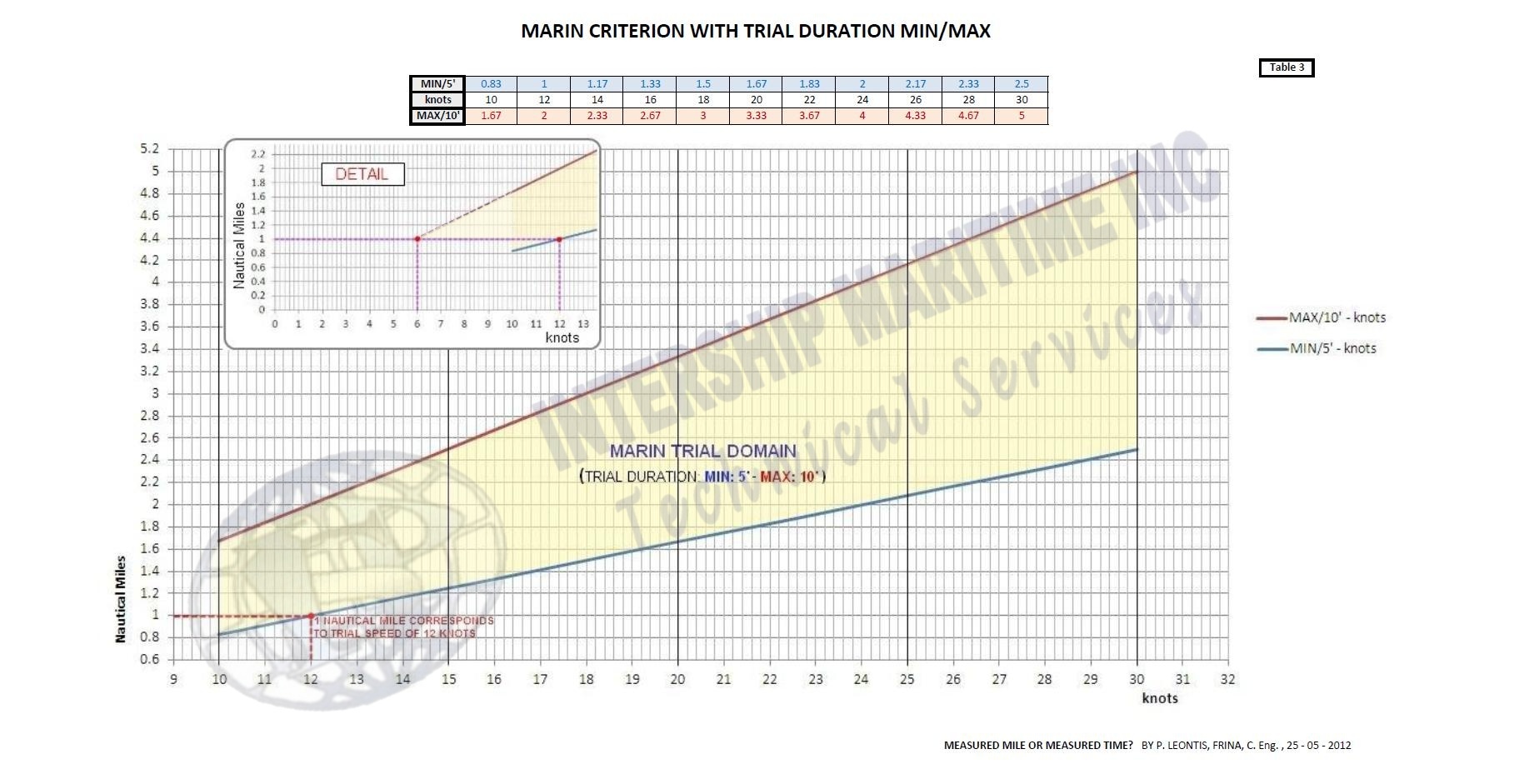
On the contrary, Table 3 illustrates MAX/MIN trial duration at various trial speeds likely to be met today. According to MARIN such a duration ensures more accuracy and the measured mile method may finally begin to fade away.
References:
Reference 1: Presentation of 3rd May 2007 to the Hellenic Joint Branch of IMarEst and RINA, by P. Leontis C Eng, FRINA, Marine Technical Consultant
• PANAMAX RUDDER REPLACEMENT AFTER LOSS AT SEA
• NEW MANOEUVRING CHARACTERISTICS AS MEASURED BY D.GPS SHIP AND SHORE STATION DURING SEA-TRIALS.
• COMPARISON WITH IMO MANOEUVRING REQUIREMENS.
Reference 2:
DIFFERENTIAL GPS APPLICATIONS TO SHIP SEA TRIALS
INTERNATIONAL SEMINAR – CONFERENCE PROCEEDINGS
GENOVA, 31st MARCH 1995
Reference 3:
(Author correspondence with MARIN – 11 November 2012)
From earlier trial experience we learned that during the trial run often some very low frequency changes of the speed can occur due to either low frequency wave components (so called second order wave drift forces which behave with the wave grouping frequency and can be close to 1 minute! ) or other LF contributions. These determine the time needed for the measurement. Making runs too long causes too large deviations due to changing current.